
The Complete Guide to Agentic Growth Strategists: The Future of Marketing Strategy Has Arrived
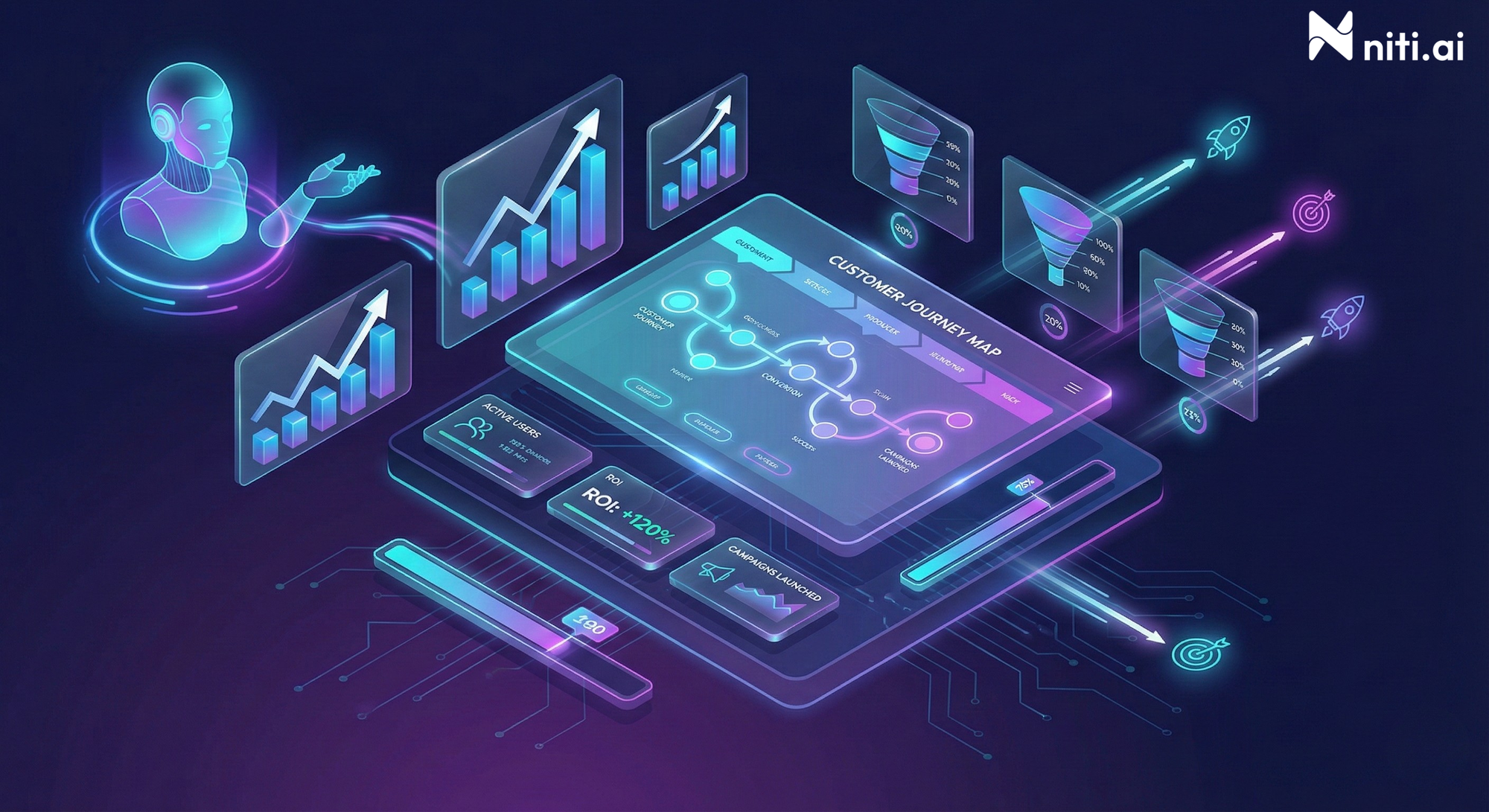
The marketing function is experiencing its most profound transformation in decades. While brands have automated email sends, optimized ad bids, and streamlined campaign execution, one critical function has remained stubbornly manual: strategic thinking itself.
That's changing. Agentic Growth Strategists represent a fundamental shift in how marketing strategy gets created, evaluated, and executed—moving from quarterly planning cycles and human-dependent analysis to continuous, autonomous strategy generation powered by AI agents.
This isn't about chatbots writing email copy or AI tools suggesting subject lines. This is about autonomous AI systems that can analyze hundreds of customer data points, identify high-impact growth opportunities, design comprehensive multi-campaign strategies, optimize for profitability (not just conversion), and produce ready-to-execute plans—continuously, at scale, without human intervention for every decision.
For mid-market D2C brands spending $30K-200K monthly on customer acquisition while drowning in retention complexity, this represents a complete reimagining of how growth happens.
Part 1: What Is an Agentic Growth Strategist?
The Core Definition
An Agentic Growth Strategist is an autonomous AI agent—or orchestrated team of specialized agents—that performs the complete role of a human growth strategist. This means:
- Autonomously analyzing customer data across 100+ behavioral, transactional, and engagement features
- Identifying high-impact growth opportunities through pattern recognition and anomaly detection
- Creating comprehensive, mutually exclusive and collectively exhaustive (MECE) campaign strategies
- Designing margin-aware offers tailored to specific customer segments
- Producing ready-to-execute campaign briefs with targeting logic, messaging direction, and timing sequences
- Optimizing continuously based on performance data and changing customer behavior
The key differentiator: This isn't a tool that assists human strategists—it replaces the strategic function itself while operating 24/7 with minimal human oversight.
The Six Key Characteristics
1. Autonomous Operation
Unlike traditional marketing tools that require human direction for each task, Agentic Growth Strategists operate independently. They monitor customer data continuously, identify opportunities as they emerge, and generate strategies without waiting for quarterly planning cycles or human prompts.
2. Force Multiplier
“This isn’t simple augmentation—it’s a force multiplier. Instead of 2–3 comprehensive strategies per week, teams using an Agentic Growth Strategist can generate 10+ without sacrificing depth or strategic rigor.”
3. Continuous Strategy Generation
Rather than batch processing or on-demand analysis, these systems operate continuously. They don't wait for monthly reviews—they detect a 15% uptick in a specific customer segment's engagement and immediately generate a targeted reactivation strategy.
4. Data-Driven Decisions at Scale
Human strategists can realistically analyze 10-20 customer variables when creating segments. Agentic Growth Strategists analyze 100+ features simultaneously—purchase recency and frequency, product affinity patterns, margin contribution, engagement trajectory, discount sensitivity, channel preference, lifecycle stage, and dozens more—to create precision-targeted strategies impossible for humans to replicate manually.
5. Profit Optimization Focus
This is where Agentic Growth Strategists diverge most sharply from existing marketing automation. Rather than optimizing for engagement metrics or revenue alone, they optimize for customer-level profitability. They understand that a 25% discount to a high-LTV customer erodes margin unnecessarily, while that same customer might respond equally well to early access or VIP perks.
6. Multi-Agent Architecture
The most sophisticated Agentic Growth Strategists don't rely on a single AI model making all decisions. Instead, they orchestrate specialized agents—each focused on a specific domain (insights, segmentation, offer design, channel strategy, execution planning)—working together as a unified system, much like a human growth team with distributed expertise.
Why "Agentic" Matters
The term "agentic" isn't marketing jargon—it reflects a fundamental architectural shift in AI capabilities.
Traditional AI systems—even advanced ones—are reactive. They respond to prompts, answer questions, or execute predefined workflows. They're powerful assistants but require human direction.
Agentic AI systems are proactive and autonomous. They can:
- Set their own goals based on business objectives
- Plan multi-step workflows to achieve those goals
- Execute actions across multiple systems
- Learn from outcomes and adjust strategies
- Coordinate with other agents to accomplish complex tasks
This shift from reactive to agentic is enabled by recent advances in reasoning models (like Claude Sonnet 4, GPT-4), multi-agent orchestration frameworks (like LangGraph), and modern data infrastructure that supports real-time decision-making.
Part 2: How Agentic Growth Strategists Differ From Everything Else
Understanding what Agentic Growth Strategists are requires understanding what they're not.
What they do:
Triple Whale, Northbeam, Glew show you what happened—attribution data, cohort analysis, LTV trends.
What Agentic Growth Strategists do:
Create what to do next. They don't just show that your D30 cohort retention dropped 8%—they generate a comprehensive winback strategy with segment-specific offers, channel sequencing, and margin-aware discount levels.
The difference: Analytics → Strategy


What they do:
Hightouch, Census sync data you define to destinations you specify. You decide the segments, the timing, the logic—they handle the pipes.
What Agentic Growth Strategists do:
Generate the segmentation logic, determine optimal timing, design the offers, and orchestrate execution. The "what" and "when" are autonomous, not human-defined.
The difference: Infrastructure → Intelligence
What they do:
Klaviyo, MoEngage, Braze execute campaigns you create. You design the flow, write the copy, define the segments—they handle sends.
What Agentic Growth Strategists do:
Create the campaigns themselves. They determine which customers need which messages, design offer structures, specify channel sequences, and provide execution-ready briefs.
The difference: Execution → Creation


What they do:
Segment, mParticle collect and route data. They unify customer profiles and send data where you need it.
What Agentic Growth Strategists do:
Analyze unified data, identify strategic opportunities, generate campaign strategies, and activate execution plans.
The difference: Pipes → Strategist
What they do:
Copy.ai, Jasper generate content and copy based on prompts you provide.
What Agentic Growth Strategists do:
Generate complete growth strategies—determining who to target, with what offers, through which channels, at what frequency, optimized for which outcome—then provide content direction as one component of comprehensive campaign briefs.
The difference: Content → Strategy


What they do:
Analyze customer data (10-15 hours/week), create retention strategies (5-8 hours/week), perform margin calculations (2-3 hours/week), coordinate execution (3-5 hours/week). Total: 20-30 hours/week. Output: 2-3 comprehensive strategies per week.
What Agentic Growth Strategists do:
Continuous data monitoring (24/7), autonomous opportunity identification, instant margin calculations, 10+ comprehensive strategies per week, zero manual hours for routine analysis.
The difference: Human → AI
The cost difference: $150K/year + 6-12 months to hire vs. $15K/year + 2 weeks to deploy
Part 3: Why This Category Exists Now (And Not Five Years Ago)
Five converging forces have created both the demand and the technical capability for Agentic Growth Strategists to emerge as a distinct category.
Market Force #1: The Labor Cost Crisis
Mid-market D2C brands ($5-50M revenue) face an impossible equation:
- They need sophisticated retention strategies to compete with larger brands and offset rising customer acquisition costs
- They can't afford dedicated growth strategists ($120-150K salary + benefits) or retain specialized agencies ($15-30K/month)
- They can't find qualified talent even when they can afford it (6-12 month hiring cycles, high turnover)
The alternative—asking founders or CMOs to manually analyze cohorts, calculate segment-level margins, and design multi-campaign strategies—doesn't scale beyond $5-10M revenue.
Agentic Growth Strategists solve this by providing equivalent strategic output at 90% lower cost with zero hiring delays.
Market Force #2: Speed Requirements
Consumer behavior changes faster than quarterly planning cycles can accommodate. Brands need to:
- Launch 10+ targeted campaigns weekly (not 2-3)
- Respond to real-time signals (inventory shifts, competitor moves, seasonal trends) within hours (not weeks)
- Test dozens of segment-offer combinations monthly to find optimal strategies
Human strategists can't maintain this pace. Even well-resourced teams struggle to generate more than 10-12 comprehensive strategies monthly. Agentic systems can generate 40-50, each tailored to specific customer segments with margin-aware offer optimization.
Market Force #3: Data Complexity
Modern customer data environments include:
- 100+ behavioral features (purchase patterns, engagement trends, product affinities)
- Real-time signals (browse behavior, cart abandonment, email interactions)
- Cross-channel activity (email, SMS, WhatsApp, push notifications, on-site behavior)
- Margin data (COGS, contribution margins, discount history)
- Predictive scores (churn risk, LTV forecasts, propensity models)
Human strategists realistically analyze 10-20 variables when creating segments. Sophisticated analysis of 100+ features simultaneously—finding multivariate patterns humans miss—requires computational power humans can't match.
Market Force #4: Margin Pressure
The "discount death spiral" is real:
- Average D2C brand offers 15-25% discounts to drive repeat purchases
- These blanket discounts erode 15-25% of margin
- High-LTV customers who would have purchased anyway receive unnecessary discounts
- Low-LTV, discount-sensitive customers train themselves to wait for promotions
The insight: Not all customers need the same incentive. Some respond to early access, others to free shipping, others to 10% off—and some need nothing at all.
Margin-aware optimization—understanding which customers need which incentives at which price points—requires analyzing customer-level profitability data at scale. This is what Agentic Growth Strategists are purpose-built to do.
Technology Enabler #1: Reasoning Models
The emergence of advanced reasoning models (Claude Sonnet 4, GPT-4 and beyond) has fundamentally changed what AI can do:
- Pre-2024 AI: Pattern matching, classification, prediction. Could identify that retention dropped but couldn't explain why or what to do about it.
- 2024+ AI: Reasoning, synthesis, strategic planning. Can analyze complex customer data, identify causal relationships, generate multi-step strategies, and explain the strategic rationale.
This shift from prediction to reasoning is what makes autonomous strategy generation possible.
Technology Enabler #2: Multi-Agent Orchestration
Frameworks like LangGraph enable coordinating multiple specialized AI agents—each focused on specific domains—working together as a unified system. This mirrors how human growth teams operate (analysts, strategists, channel specialists) but at machine speed and scale.
Technology Enabler #3: Modern Data Infrastructure
Real-time CDPs, event streaming platforms, cloud data warehouses (BigQuery, Snowflake), and API-first SaaS tools create the data infrastructure Agentic Growth Strategists need to:
- Access real-time customer data
- Generate and execute segmentation logic
- Push audiences to execution channels (email, SMS, WhatsApp)
- Track performance and optimize continuously
Technology Enabler #4: Integration Ecosystem
Shopify, Klaviyo, MoEngage, WhatsApp Business API, and hundreds of other platforms offer robust APIs that enable autonomous systems to:
- Pull customer data
- Push audience segments
- Track campaign performance
- Update customer profiles
Without these API ecosystems, Agentic Growth Strategists would remain conceptual. With them, autonomous strategy-to-execution becomes technically feasible.
Market Readiness: The Mindset Shift
Five years ago, CMOs weren't comfortable delegating strategic decisions to AI. Today:
- CMOs increasingly accept AI for strategic work (not just tactical execution), especially as reasoning models demonstrate human-level strategic capabilities
- CFOs demand measurable labor savings and ROI—Agentic Growth Strategists provide clear unit economics (replace $150K role with $15K subscription)
- Mid-market brands recognize they need sophisticated strategies but can't afford dedicated teams—creating perfect conditions for AI-powered alternatives
Part 4: The Anatomy of an Agentic Growth Strategist
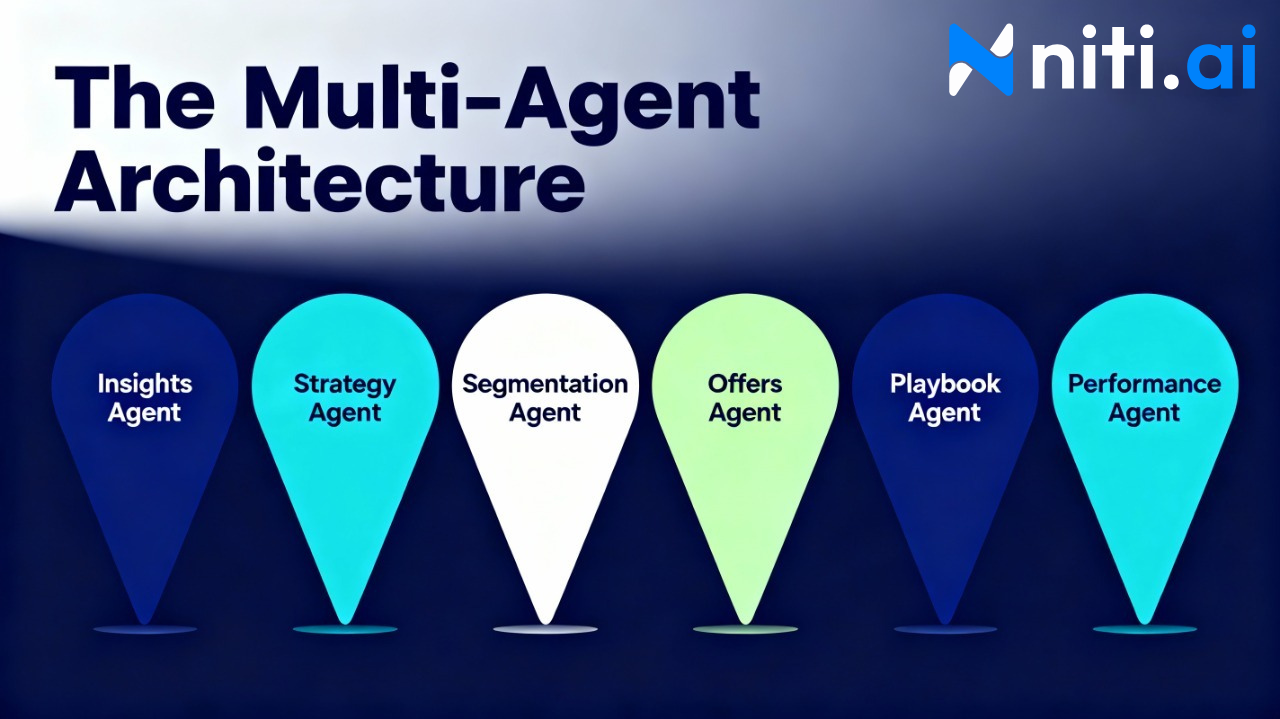
The most sophisticated Agentic Growth Strategists aren't single AI models—they're orchestrated systems of specialized agents, each focused on specific domains, working together as a unified growth team.
The Multi-Agent Architecture
Agent 1: Insights Agent
- Function: Monitors 100+ customer features daily
- Outputs: Flags opportunities (anomalies, trends, patterns) prioritized by potential impact
- Example: "15% uptick in D60-D90 inactive customers showing browse activity—suggests timing opportunity for winback campaign"
Agent 2: Strategy Agent
- Function: Generates MECE (mutually exclusive, collectively exhaustive) campaign bundles
- Outputs: Multi-campaign strategies ensuring comprehensive coverage without overlap
- Example: "Generate three parallel campaigns targeting different inactive segments (D30-60, D60-90, D90+) with non-overlapping audiences and distinct value propositions"
Agent 3: Segmentation Agent
- Function: Builds precise customer segments based on strategy requirements
- Outputs: SQL queries + human-readable definitions + audience counts
- Example: "High-LTV customers (top 20% by predicted CLV) who purchased 2+ times in past 180 days, zero purchases in past 45 days, high email engagement (>40% open rate)"
Agent 4: Offers Agent
- Function: Designs margin-aware offers per segment
- Outputs: Optimal incentive levels balancing conversion probability vs. profitability
- Example: "For high-LTV segment: 10% discount with free shipping (margin-preserving). For discount-sensitive segment: 20% off (acquisition-focused, acceptable margin trade-off)"
Agent 5: Playbook Agent
- Function: Creates channel-specific execution plans
- Outputs: Timing sequences, copy direction, creative requirements
- Example: "Day 1: Email with personalized subject line. Day 3: SMS reminder. Day 7: WhatsApp with product recommendations based on browse history"
Agent 6: Performance Agent
- Function: Monitors campaign results and recommends optimizations
- Outputs: Performance dashboards, anomaly alerts, optimization recommendations
- Example: "Campaign 3 underperforming (12% below forecast). Recommend: increase offer to 15% for remaining audience, extend campaign window by 3 days"
How The Agents Work Together
The orchestration flow:
- Insights Agent detects opportunity → flags to Strategy Agent
- Strategy Agent designs campaign bundle → requests segments from Segmentation Agent
- Segmentation Agent builds audiences → passes to Offers Agent
- Offers Agent designs incentive structures → passes to Playbook Agent
- Playbook Agent creates execution plans → hands off to marketing ops or automation platform
- Performance Agent monitors results → feeds learnings back to Strategy Agent for continuous optimization
This multi-agent architecture enables sophisticated strategic capabilities no single model could achieve, while maintaining the transparency and explain ability enterprises require.
Part 5: The Business Case: Why Agentic Growth Strategists Win
The ROI Equation
Traditional Approach:
- Human strategist: $120K salary + $30K benefits = $150K/year
- Time to hire: 6-12 months
- Ramp time: 3-6 months to full productivity
- Output: 2-3 comprehensive strategies/week = ~120/year
- Constraints: Limited by working hours, analytical capacity, needs support for execution
Agentic Growth Strategist:
- Cost: $15K/year (typical pricing)
- Time to deploy: 2 weeks
- Ramp time: Immediate full productivity
- Output: 10+ comprehensive strategies/week = 500+/year
- Constraints: None—operates 24/7, scales with data infrastructure
Year 1 savings: $135K in labor costs Ongoing savings: $135K/year + faster time-to-market + 4x more strategic output
The Margin Optimization Multiplier
Beyond labor savings, margin-aware optimization delivers additional ROI:
- Average D2C brand: $5M revenue, 40% gross margin = $2M gross profit
- Typical over-discounting: 15-20% of revenue given as unnecessary discounts
- Annual waste: $750K-1M in margin erosion
Margin-aware Agentic Growth Strategists reduce this waste by:
- Segmenting customers by discount sensitivity
- Offering non-monetary incentives (early access, VIP perks) to high-LTV customers
- Reserving discounts for truly price-sensitive segments
- Typical margin recapture: $50-150K annually
Total ROI: $185-285K/year for a $15K investment = 12-19x return
The Speed-to-Market Advantage
In fast-moving consumer categories:
- 2-week strategy delay = missed revenue opportunity
- Real-time response to competitor moves = competitive advantage
- Continuous testing and optimization = compounding performance gains
Brands using Agentic Growth Strategists report:
- 40-60% faster campaign launch cycles
- 25-40% improvement in campaign performance (through continuous optimization)
- 3-5x increase in testing velocity (enabling faster learning)
Part 6: Implementation: How Brands Deploy Agentic Growth Strategists
The 90-Day Roadmap
Weeks 1-2: Foundation & Integration
- Connect data sources (Shopify, Klaviyo/MoEngage, customer data)
- Map business context (brand positioning, product catalog, margin data)
- Define success metrics and reporting cadence
Weeks 3-6: First Strategies
- System generates initial campaign strategies
- Marketing team reviews and approves
- Launch first 3-5 campaigns
- Establish approval workflows
Weeks 7-10: Scale & Optimization
- Expand to 10+ campaigns weekly
- Performance monitoring and refinement
- Team becomes comfortable with AI-generated strategies
- Approval rates increase as trust builds
Weeks 11-12: Autonomous Operation
- System operates with minimal oversight
- Performance dashboards replace manual reviews
- Team focuses on high-value creative work and strategic oversight rather than routine analysis
The Approval Evolution
Phase 1 (Weeks 1-4): 100% human approval
- Every strategy reviewed before execution
- Team learns system logic and capabilities
- Building trust in AI recommendations
Phase 2 (Weeks 5-8): Selective approval
- Low-risk strategies auto-approved
- High-impact campaigns reviewed
- ~70% approval rate
Phase 3 (Weeks 9+): Autonomous with oversight
- System auto-approves standard campaigns
- Human review for new segment types or high-value offers
- ~90% approval rate
- Monthly strategy reviews replace daily approvals
The Integration Landscape
Agentic Growth Strategists integrate with existing martech stacks:
Data Sources:
- E-commerce platforms (Shopify, WooCommerce)
- CDPs (Segment, mParticle)
- Marketing automation (Klaviyo, MoEngage, Braze)
- Analytics (Google Analytics, Mixpanel)
- Attribution (Northbeam, Triple Whale)
Execution Channels:
- Email (Klaviyo, Iterable, SendGrid)
- SMS (Twilio, Attentive)
- WhatsApp (WhatsApp Business API)
- Push notifications (OneSignal, Airship)
The key: Agentic Growth Strategists sit above these systems as a strategy layer—generating campaigns and pushing execution to existing tools rather than replacing them.
Part 7: The Competitive Landscape & Positioning
Who Competes for the Same Budget?
When brands consider Agentic Growth Strategists, they're typically evaluating against:
1. Replacing Human Constraint With a Force Multiplier Model (40% of competitive encounters)
- Advantage: Human strategists bring judgment, creative intuition, and deep company-specific context.
- Disadvantage: Costly ($150K/year), slow to hire (6–12 months), and limited to 2–3 comprehensive strategies per week.
- Agentic Growth Strategist Positioning: Delivers 90% cost savings, 4× output, and two-week deployment—a true force multiplier that enables teams to generate 10+ high-rigor strategies weekly without adding headcount.
2. Data Activation Platforms (Hightouch, Census) (25% of encounters)
- Advantage: Powerful data syncing, flexible segment building
- Disadvantage: Requires humans to define segments and strategies—doesn't generate intelligence
- Agentic Growth Strategist positioning: "We generate the segments and strategies—not just sync them"
3. "Using Klaviyo Better" (20% of encounters)
- Advantage: Already implemented, familiar to team
- Disadvantage: Reactive flows, not proactive strategies; engagement-optimized, not margin-aware
- Agentic Growth Strategist positioning: "We complement Klaviyo by generating the strategies it executes"
4. DIY/Build In-House (10% of encounters)
- Advantage: Complete control, custom to business needs
- Disadvantage: $500K-2M to build, 12-18 months, ongoing ML/engineering costs
- Agentic Growth Strategist positioning: "Category-leading solution at 1% the cost of building in-house"
5. Analytics Platforms (Triple Whale, Northbeam) (5% of encounters)
- Advantage: Attribution visibility, cohort analysis
- Disadvantage: Shows what happened, doesn't create what to do next
- Agentic Growth Strategist positioning: "We turn your attribution insights into executable strategies"
Part 8: The Future: Where Agentic Growth Strategists Are Headed
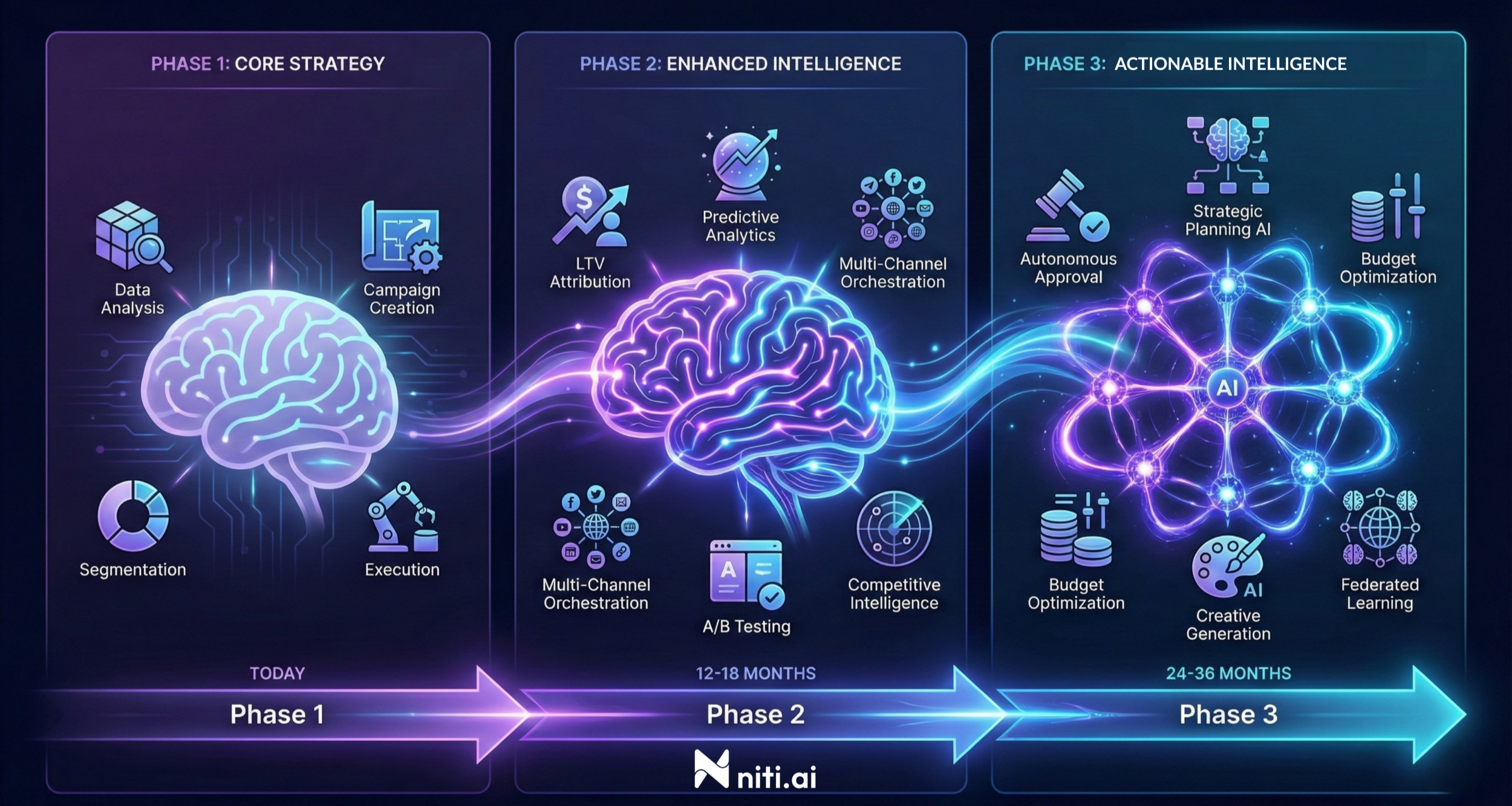
Phase 1 (Current): Core Strategy Generation
Today's Agentic Growth Strategists focus on:
- Opportunity identification from customer data
- Campaign strategy generation
- Segment-specific offer design
- Execution playbook creation
- Performance monitoring
This establishes the category and proves core value.
Phase 2 (12-18 months): Enhanced Intelligence
Next-generation capabilities include:
- LTV-aware attribution: Understanding which acquisition channels drive high-retention customers
- Predictive campaign performance: Forecasting results before launch
- Multi-channel orchestration: Optimizing sequencing across email, SMS, WhatsApp, push
- A/B test design: Autonomous experimentation to optimize offers and messaging
- Competitive intelligence: Monitoring competitor strategies and automatically generating counter-moves
Phase 3 (24-36 months): Autonomous Growth Operating System
The end state vision:
- Fully autonomous operation: Auto-approval of low-risk campaigns within predefined guardrails
- Strategic planning intelligence: Quarterly growth planning generated by AI
- Budget optimization: Autonomous allocation of marketing spend across channels
- Creative generation: AI-written copy and visual assets tailored to segments
- Privacy-preserving analytics: Federated learning enabling cross-brand intelligence without data sharing
Part 9: Getting Started: Evaluating Agentic Growth Strategists
The Evaluation Framework
When assessing Agentic Growth Strategist solutions, evaluate on these dimensions:
1. True Autonomy vs. Assisted Workflows
- Does it generate strategies independently, or does it require human input for each decision?
- Can it operate continuously (24/7) or only on-demand?
2. Strategy Depth
- Does it produce comprehensive, execution-ready campaign briefs?
- Does it optimize for profitability or just engagement/revenue?
3. Multi-Agent Architecture
- Single model or orchestrated system of specialized agents?
- Transparency in agent decision-making and reasoning?
4. Margin Awareness
- Does it understand customer-level profitability?
- Can it design differentiated offers based on LTV and discount sensitivity?
5. Integration Breadth
- Works with existing martech stack or requires replacement?
- API-first for data access and campaign execution?
6. Proof of Value Timeline
- How long until measurable impact?
- What metrics define success?
7. Approval & Governance Model
- How much human oversight required?
- Can approval workflows evolve as trust builds?
Red Flags to Watch For
- "AI-powered" without specifics: Many tools add AI features but aren't truly agentic
- Single-model systems: Won't scale to complex strategic work
- Engagement-only optimization: Missing margin awareness means revenue without profitability
- Requires extensive customization: True category solutions work out-of-box with configuration, not custom builds
- No performance guarantee or proof period: Category leaders offer trial periods or proof-of-value frameworks
Conclusion: The Strategic Imperative
Agentic Growth Strategists aren't just another martech category—they represent a fundamental shift in how marketing strategy gets created, evaluated, and executed.
For mid-market D2C brands, the math is compelling:
- 90% cost savings vs. hiring human strategists
- 4x more strategic output (10+ campaigns/week vs. 2-3)
- $50-150K/year in margin optimization through intelligent offer design
- Zero hiring delays (2-week deployment vs. 6-12 months)
But the deeper value transcends cost savings: It's about democratizing sophisticated growth capabilities that were previously accessible only to brands with dedicated teams and million-dollar budgets.
The brands that embrace Agentic Growth Strategists early won't just reduce costs—they'll gain a compounding strategic advantage through:
- Faster testing and learning cycles
- More sophisticated segmentation and personalization
- Margin-aware growth that compounds profitability
- Continuous optimization that humans can't match at scale
The category is emerging now because the technology, market conditions, and mindset shifts have converged. The question for growth leaders isn't whether Agentic Growth Strategists will reshape marketing—it's whether your brand will lead this transition or follow it.
The future of growth strategy is autonomous, continuous, and margin-aware. The future is agentic.
Ready to see how Agentic Growth Strategists can transform your retention marketing? Connect with Niti AI to explore what autonomous strategy generation looks like for your brand.